

In 1958, Lucky-Goldstar began manufacturing radios in post-war South Korea. The company's advertising was straightforward: black-and-white photographs of reliable appliances, accompanied by assurances of durability and fair pricing. There were no lifestyle montages, no emotional narratives, no aspirational slogans. The message was simply: this machine will not fail you.
Sixty-seven years later, LG launched "Home, Smart Home"—a campaign showing a family seamlessly moving through spaces where appliances anticipate needs, purify air, conserve energy, and disappear into the background. The message was not about machines at all. It was about liberation.
This transformation—from component manufacturer to lifestyle narrator, from reliability to optimism, from hardware to philosophy—is the arc of LG's advertising journey. And it is, in many ways, the arc of the smart home itself.
Act I: The Foundation of Trust (1950s–1990s)
Before LG could sell the future, it needed to earn the present. Its early advertising was not glamorous; it was testimonial. Refrigerators that didn't spoil food. Washing machines that didn't tear clothes. Radios that picked up distant signals through static.
This was the era of feature demonstration. LG's print advertisements displayed cutaway diagrams of compressor technology, detailed specifications of motor power, and side-by-side comparisons with competitors. The tone was respectful of the consumer's intelligence and skeptical of marketing hyperbole.
The strategy was effective precisely because it was unambitious. LG did not claim to change lives; it claimed to preserve them. A refrigerator that kept food cold was not a miracle; it was an expectation met. By consistently meeting expectations across decades, LG accumulated something more valuable than market share: permission.
Permission to expand into new categories. Permission to enter new geographic markets. Permission, eventually, to speak not about what its products were but about what they meant.
Act II: The Declaration of Optimism (2000s)
"Life's Good"
The early 2000s marked a critical juncture for LG. The company had successfully transitioned from Korean domestic brand to global manufacturer, but it lacked emotional identity. Consumers recognized the logo but felt no connection to it.
"Life's Good" was the corrective. The slogan was deceptively simple—two words, no verbs, a period of quiet confidence. It was not a command or a question but a statement of fact. The accompanying commercials did not demonstrate product features; they demonstrated human outcomes. A refrigerator enabled a family dinner. A washing machine reclaimed a Sunday afternoon. A television transformed a living room into a cinema.
This was LG's first sustained engagement with lifestyle branding. The company had learned what Apple understood and Samsung was discovering: that technology advertising in the 21st century required translation. Consumers did not need to know how a inverter compressor worked; they needed to know what a inverter compressor did for them.
"Life's Good" provided that translation layer. It became the umbrella under which every subsequent LG campaign would shelter.
Act III: The Intelligence Infrastructure (2010s)
"ThinQ AI and the Invisible Butler"
By the 2010s, the smart home was no longer speculative. Connected appliances existed, but their advertising suffered from a credibility gap. Commercials showed families controlling their homes through voice commands and smartphone apps, but the interactions felt forced, the benefits unclear.
LG's ThinQ AI campaigns addressed this gap through subtraction. The commercials did not emphasize the novelty of voice control; they emphasized the absence of effort. A refrigerator that tracked expiration dates and suggested recipes. A washing machine that detected fabric weight and selected the optimal cycle. An oven that preheated itself based on the recipe selected.
The message was radical in its restraint: you should not have to think about your technology at all.
Link: Anuncio del asistente LG Cloi AI (2018):
"WashTower and the Choreography of Convenience"
The WashTower campaign, "No Rubbing, No Scrubbing," represented LG's most sophisticated translation of technical specification into human benefit. The product itself was a engineering achievement—a stacked washer-dryer with AI Direct Drive that sensed fabric softness and weight. But the advertising did not lead with megapixels or machine learning.
It led with time.
The commercials showed parents playing with children, couples enjoying mornings, individuals pursuing hobbies—all while the laundry completed itself in the background. The message was not about cleaning efficiency; it was about life efficiency. LG was not selling a washing machine; it was selling the hours that washing machine returned to its owner.
Act IV: The Cinema of Emotion (2010s)
"OLED and the Art of Disappearance"
LG's OLED television campaigns represented a different advertising challenge. The product category was saturated with claims of superior picture quality, and consumers had become desensitized to demonstrations of contrast ratio and color gamut.
LG's solution was to abandon technical demonstration entirely. The OLED commercials, featuring dancers like Misty Copeland, did not show the television at all until the final frames. They showed emotion—the tension of a dancer's body, the release of movement, the intimacy of performance captured in perfect black.
The message was subtle but unmistakable: LG does not sell televisions; it sells access to transcendence.
Link: Home, Smart Home | Life's Good | LG (2025):
Act V: The Sustainability Imperative (2020s)
"Life's Good Relaunch"
The 2023 relaunch of "Life's Good" was not merely a refresh; it was a redefinition. The original slogan had communicated passive optimism—an observation that life, facilitated by LG technology, was good. The new campaign communicated active responsibility: life can be good, but only if we make choices that sustain it.
The commercials featured younger protagonists, more diverse families, and explicit references to environmental consciousness. The appliances were energy-efficient, the materials were recycled, the homes were designed for minimal carbon impact. This was not greenwashing; it was earned credibility. LG had been manufacturing energy-efficient appliances for years; it was simply now telling that story with narrative priority.
Link: LG at IFA 2020 – Life's Good from Home:
"Smart Cottage and the Architecture of Tomorrow"
The Smart Cottage campaign represented LG's most ambitious narrative to date. It was not a product launch but a manifesto. The commercials depicted a complete residential ecosystem—solar-integrated roofing, water recycling systems, appliance networks that optimized energy consumption in real time.
The Smart Cottage was aspirational yet plausible, futuristic yet informed by existing LG technologies. It functioned as a proof of concept for the company's long-term vision: that the smart home would eventually become the sustainable home, and that LG would be the architect of both.
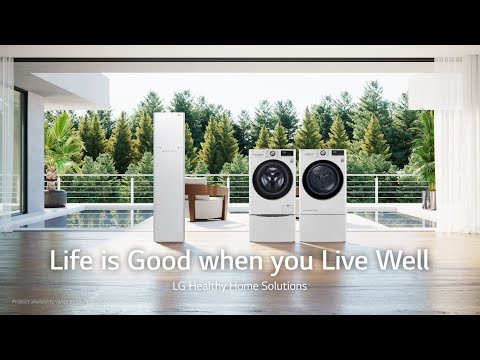
Link: LG Healthy Home Solutions (2022):
Comparative Table: LG's Narrative Evolution
| 1950s–1990s | Reliability | "It works" | Trust | Establish credibility |
| 2000s | Lifestyle integration | "It improves your life" | Optimism | Create emotional identity |
| 2010s | ThinQ AI, OLED | "It learns from you" | Liberation | Demonstrate intelligence |
| 2010s | WashTower, OLED cinema | "It disappears" | Effortlessness | Translate specs to benefits |
| 2020s | Smart Cottage, relaunch | "It protects the future" | Responsibility | Lead sustainability |
Expert Analysis: The LG Method
1. The Patience Dividend
LG's advertising journey is distinguished by its temporal scope. The company spent four decades building trust through reliability before it attempted emotional branding. It spent another two decades refining that emotional branding before it added sustainability messaging. This patience is increasingly rare in technology marketing, where brands frequently pivot strategies with each new CMO appointment.
2. Translation as Core Competency
LG's greatest advertising skill is translation. The company consistently converts technical specifications—compressor efficiency, AI processing speed, color volume—into human outcomes—food preservation, chore reduction, emotional immersion. This translation layer is not decorative; it is essential. Consumers cannot evaluate inverter technology, but they can evaluate Sunday afternoons reclaimed from laundry.
3. Consistency Without Rigidity
"Life's Good" has endured for over two decades, but its meaning has evolved significantly. The slogan has functioned as a container rather than a constraint, capable of accommodating new product categories, new geographic markets, and new cultural priorities. This flexibility explains its longevity: it has never demanded that LG remain the same.
4. The Sustainability Transition
LG's 2020s advertising represents a significant strategic bet. The company is positioning sustainability not as corporate social responsibility but as product leadership. Energy efficiency is framed as innovation, not sacrifice. Recycled materials are presented as design achievements, not compromises. This framing is essential for maintaining premium positioning while addressing environmental concerns.
Industry Impact: The Smart Home Vocabulary
LG's advertising influenced how the entire consumer electronics industry communicates about connected homes:
Samsung adopted similar lifestyle narratives, emphasizing family and convenience in its SmartThings campaigns.
Apple expanded its HomeKit advertising, though with characteristic emphasis on privacy rather than sustainability.
Xiaomi and other Chinese manufacturers have adapted LG's emotional register for emerging markets, translating "Life's Good" into local cultural frameworks.
More broadly, LG established that smart home advertising cannot be about technology. Consumers do not want to be reminded that their appliances contain processors and sensors; they want to be reassured that those processors and sensors are working on their behalf. LG's campaigns consistently prioritize this reassurance over demonstration.
Conclusion: The House That LG Built
The smart home is no longer a futuristic concept; it is a retail category. Consumers can purchase connected refrigerators, AI-powered washing machines, and voice-controlled lighting systems at any appliance retailer. The technology is mature, the infrastructure is established, and the competitive landscape is crowded.
What remains scarce is meaning.
Consumers do not buy smart appliances because they desire connectivity; they buy them because they desire the outcomes connectivity enables: convenience, efficiency, peace of mind, sustainability. LG understood this distinction earlier and articulated it more consistently than any competitor.
"Life's Good" is not a claim about LG's products. It is a claim about LG's customers: that their lives, facilitated by thoughtfully designed technology, are worthy of optimism. This claim has sustained the brand through six decades of technological revolution, from vacuum tubes to neural networks, from domestic Korean markets to global category leadership.
The Smart Cottage may never be mass-produced. The ThinQ AI platform may be superseded by newer architectures. Even "Life's Good" will eventually retire, replaced by whatever slogan articulates the next era of LG's relationship with its customers.
But the orientation will persist. LG learned, through decades of patient advertising, that technology brands are not judged by their innovations but by their intentions. A company that consistently demonstrates respect for its customers' time, attention, and values earns the right to participate in their lives.
The radios of 1958 are obsolete. The refrigerators of 1985 are museum pieces. The smart homes of 2025 will, in turn, become artifacts of a particular technological moment.
But the trust LG accumulated through seventy years of honest communication—that remains current. That remains the point.
In the history of advertising, most technology campaigns age poorly. Specifications become laughable. Design languages date. Slogans that once seemed profound become embarrassing.
LG's campaigns do not age. Not because they were ahead of their time, but because they were never about their time. They were about the timeless aspiration for a good life, enabled by machines that respect the humans who use them.
That aspiration does not become obsolete. It only becomes more urgent.
Discover the talented actress featured in the LG smart home appliances ad. Uncover her background and other roles that showcase her impressive skills.
Discover how LG is transforming smart device advertising with innovative strategies and cutting-edge technology to enhance user engagement and brand visibility.

Discover how Netflix leverages drama in its advertising campaigns to captivate audiences and enhance viewer engagement. Explore the art of storytelling in ads.

Discover the iconic Adidas ads that shaped Olympic campaigns, showcasing creativity and athleticism. Explore the impact of these memorable marketing moments.

Discover how Samsung Ads revolutionized smartphone marketing, enhancing brand visibility and consumer engagement through innovative advertising strategies.

Discover how Jeep ads have shaped automotive culture, influencing trends and consumer perceptions. Explore the legacy of iconic campaigns and their impact.

Discover Subway's most memorable advertising slogans that have shaped its brand identity. Explore the creativity behind each catchy phrase and their impact.

Discover how Motorola's innovative advertising strategies are driving global expansion and reshaping the tech landscape. Explore the impact today.

Discover how Netflix masterfully uses nostalgia in its advertising to connect with audiences and evoke powerful emotions. Explore the strategy behind the success.

Discover how Adidas leverages global sports campaigns to enhance brand visibility and connect with fans worldwide. Explore innovative advertising strategies today.