

In 1965, Fred DeLuca borrowed $1,000 from a family friend to open a sandwich shop in Bridgeport, Connecticut. He was seventeen years old. His business plan consisted of a single proposition: make sandwiches quickly, sell them cheaply, and hope customers arrived.
Sixty years later, Subway is the largest fast-food chain in the world by number of locations. Its sandwiches are served in over 100 countries, from shopping malls in Shanghai to highway rest stops in Spain. This expansion was not powered by revolutionary cuisine or proprietary technology. It was powered, in substantial measure, by words.
Subway's advertising slogans are not merely marketing artifacts; they are cultural infrastructure. "Eat Fresh" encoded a health consciousness that Subway did not invent but successfully claimed. "Five Dollar Footlong" transformed a pricing promotion into a collective incantation, repeated by millions who had never seen the original commercial. These phrases did not describe Subway's offerings; they defined them.
This is the story of how a Connecticut sandwich shop learned to speak to the world—and how its words became part of the language of lunch itself.
Act I: The Customization Proposition (1985–1990)
"My Way"
In the 1980s, fast food was defined by rigidity. McDonald's sold hamburgers prepared identically in every location; Burger King's "Have It Your Way" was the exception that proved the rule. Subway's "My Way" campaign recognized an opportunity: the sandwich format was inherently customizable in ways that burgers and tacos were not.
The slogan was deceptively simple. Two words, first-person possessive. It did not claim superiority; it claimed deference. Subway was not telling customers what to eat; it was asking customers what they wanted to eat. This positioning was radical in a category defined by product-centric marketing.
"My Way" established Subway's foundational advertising principle: the customer is the protagonist. The brand's subsequent campaigns would refine and redirect this insight, but never abandon it.
Act II: The Freshness Differentiation (1990–1995)
"The Place Where Fresh Is the Taste"
By the early 1990s, Subway had established its customization credentials but lacked a competitive differentiator. Every fast-food chain claimed to serve quality food; few could substantiate the claim. Subway's kitchens were visible, its vegetables were delivered daily, and its bread was baked on-site. These were genuine advantages—if consumers could be persuaded to value them.
"The Place Where Fresh Is the Taste" was Subway's first sustained freshness narrative. The slogan was grammatically awkward—"The Place Where Fresh Is the Taste" strained conventional syntax—but this awkwardness was itself strategic. It signaled that Subway was not merely adopting industry terminology but claiming proprietary territory.
The campaign's commercials emphasized visual evidence: bakers removing bread from ovens, employees slicing vegetables, sandwiches assembled in real time. This was advertising as testimony, not assertion. Subway was not asking consumers to trust its claims; it was showing them the evidence.
Link: Subway "The Place Where Fresh Is the Taste" (1994):

Act III: The Universal Declaration (2000–Present)
"Eat Fresh"
In 2000, Subway condensed its freshness narrative into two words. "Eat Fresh" was not a description of Subway's products; it was a philosophical imperative. The slogan addressed the consumer directly, in the second-person singular, commanding a behavior rather than promoting a purchase.
This was Subway's most significant linguistic innovation. Previous slogans had been about Subway: its customization options, its freshness practices, its sandwich quality. "Eat Fresh" was about the consumer: their health, their choices, their lifestyle. Subway was no longer selling sandwiches; it was selling self-improvement through consumption.
The slogan's timing was propitious. The early 2000s marked the mainstreaming of health consciousness in American food culture. Low-carb diets, nutritional labeling, and public health campaigns had created an audience primed to associate "fresh" with "virtuous." Subway claimed this association before competitors recognized its value.
The Jared Fogle campaign, launched concurrently with "Eat Fresh," provided the slogan with human evidence. Fogle's dramatic weight loss, attributed to a diet of Subway sandwiches, transformed "Eat Fresh" from brand promise to personal testimony. The campaign was enormously effective—and, in retrospect, enormously problematic. Fogle's subsequent criminal convictions have permanently tainted this chapter of Subway's advertising history.
Yet "Eat Fresh" itself survived the scandal. The slogan had become detached from its most famous spokesperson, embedded in Subway's brand architecture as foundational principle rather than campaign tagline. It remains the brand's most durable and recognizable phrase.
Link: Subway "Eat Fresh" Ad (2021 Relaunch):

Act IV: The Viral Interlude (2008–2014)
"Five Dollar Footlong"
The "Five Dollar Footlong" campaign was an advertising singularity—a phenomenon so culturally pervasive that it transcended the category of marketing and entered the category of folklore.
The slogan's success was not attributable to creative sophistication. The commercials were intentionally rudimentary: a simple jingle, repetitive lyrics, minimal production values. This aesthetic was not accidental; it was memetic engineering. The jingle was designed to be hummed, sung, and parodied—to propagate through cultural transmission rather than paid distribution.
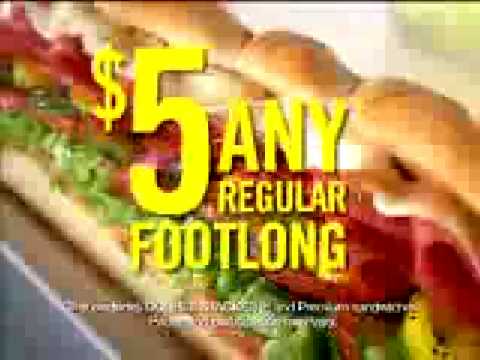
The campaign generated $3.8 billion in revenue during its first year. More significantly, it transformed "footlong" from a menu descriptor into a unit of currency. Consumers did not order "a twelve-inch sandwich"; they ordered "a five-dollar footlong." The phrase entered vernacular usage, cited in television shows, referenced in music lyrics, and deployed in countless parodies.
"Five Dollar Footlong" demonstrated that Subway's advertising strength was not limited to health positioning. The brand could also compete on affordability and fun—registers previously dominated by Taco Bell and McDonald's.
Link: Subway Five Dollar Footlong Commercial (2009):
Act V: The Crisis Response (2015–2016)
"Founded on Fresh"
The Jared Fogle scandal created a reputational emergency for Subway. The brand's most recognizable spokesperson had been revealed as a consumer of child sexual abuse material. Every advertisement featuring Fogle became radioactive. Every association with his weight-loss narrative became contaminated.
Subway's response was "Founded on Fresh"—a slogan that deliberately shifted temporal focus from the recent past to the distant past. The campaign emphasized Subway's 1965 origins, its founder's entrepreneurial story, its decades of freshness commitment. The message was implicit but unmistakable: Jared Fogle is not Subway. Subway existed before him and will exist after him.
"Founded on Fresh" was not a creative triumph; it was a strategic necessity. The slogan functioned as narrative insulation, protecting Subway's core brand equity from association with an individual who had betrayed it. Its relative forgettability was, paradoxically, evidence of its effectiveness. Successful crisis advertising does not draw attention to itself; it redirects attention away from the crisis.
Act VI: The Modernization (2021–Present)
"Eat Fresh, Refresh"
Subway's 2021 slogan update, "Eat Fresh, Refresh," represented a generational recalibration. The original "Eat Fresh" had been introduced in 2000; consumers who encountered it as children were now adults with their own families. The brand needed to signal relevance to new audiences without alienating existing customers.
"Eat Fresh, Refresh" acknowledged that Subway's offering had evolved—new ingredients, updated recipes, renovated restaurants—while maintaining continuity with its defining philosophy. The slogan was not a replacement but an amendment.
The campaign's creative execution emphasized culinary craftsmanship and ingredient quality, responding to the elevated expectations of contemporary fast-food consumers. Subway was no longer competing primarily on health and affordability; it was competing on taste and experience. "Eat Fresh, Refresh" claimed that Subway had improved without abandoning its essential character.
Link: Subway "Eat Fresh" Ad (2021 Relaunch): https://www.youtube.com/watch?v=cz_q34URLM
Comparative Table: Subway's Linguistic Evolution
| My Way | 1985–1990 | Customization | Establish customer-centric identity | Rigid fast-food menus |
| The Place Where Fresh Is the Taste | 1990–1995 | Freshness demonstration | Differentiate from competitors | Rising health consciousness |
| The Way a Sandwich Should Be | 1996–2000 | Premium authenticity | Support global expansion | Fast-food premiumization |
| Eat Fresh | 2000–present | Health imperative | Claim wellness territory | Mainstreaming of diet culture |
| Five Dollar Footlong | 2008–2014 | Affordable indulgence | Drive traffic and revenue | Post-recession value sensitivity |
| Founded on Fresh | 2015–2016 | Heritage protection | Crisis management | Celebrity endorsement risk |
| Eat Fresh, Refresh | 2021–present | Modernized continuity | Generational relevance | Culinary elevation trends |
Expert Analysis: The Subway Linguistic Method
1. Command as Invitation
Subway's most effective slogans have been imperatives—"Eat Fresh," "Refresh"—that function as invitations rather than commands. This grammatical construction positions the brand as coach rather than authority, guide rather than dictator. Consumers comply because they perceive compliance as self-improvement, not submission.
 Watch YouTube video
2. The Viral Cadence
"Five Dollar Footlong" succeeded because its rhythmic structure was optimized for oral transmission. The phrase's meter (DA-da-DA-da-DA-da) matches common English speech patterns; its internal rhyme ("five"/"long") enhances memorability. Subway did not merely create an advertisement; it created a contagion.
3. Slogan Stacking
Unlike brands that discard previous slogans when adopting new ones, Subway has maintained continuous activation of its most successful phrases. "Eat Fresh" has co-existed with subsequent taglines, functioning as brand mantra while newer slogans address specific strategic objectives. This stacking approach maximizes return on prior advertising investment.
4. Crisis Through Continuity
"Founded on Fresh" demonstrated that crisis advertising need not invent new brand claims; it can reactivate existing equity. The slogan contained no information that Subway had not previously communicated. Its effectiveness derived entirely from its redirective function—shifting attention from scandalous present to honorable origins.
Industry Impact: The Fast-Food Lexicon
Subway's slogan evolution influenced the entire quick-service restaurant category:
Chipotle adopted Subway's freshness positioning with "Food With Integrity," emphasizing ingredient sourcing and sustainable agriculture.
Panera expanded Subway's customization narrative with "You Are Here" and "Food As It Should Be," positioning itself as premium alternative.
Taco Bell replicated Subway's viral jingle strategy with "Live Más" and its transformation into lifestyle branding.
McDonald's has increasingly emphasized fresh beef and ingredient quality, directly responding to the expectations Subway cultivated.
More broadly, Subway demonstrated that fast-food brands can sustain multiple simultaneous brand narratives. "Eat Fresh" and "Five Dollar Footlong" addressed different consumer motivations—health and value, virtue and indulgence—yet coexisted without contradiction. This narrative flexibility is essential for brands serving diverse, non-segmented audiences.
Conclusion: The Sandwich That Learned to Speak
Subway's advertising journey is a case study in linguistic accumulation. The brand did not abandon its successful slogans; it archived them, preserving their equity while layering new messages above them. "My Way" remains present in Subway's DNA, even though no current advertisement features the phrase. "Eat Fresh" continues to function as brand mantra, even as "Refresh" claims contemporary attention.
This accumulation gives Subway's advertising unusual temporal depth. The brand can activate nostalgia when appropriate, deploy value messaging when necessary, emphasize health credentials when advantageous. Its slogan library is a strategic asset, not merely historical artifact.
The sandwich itself remains largely unchanged. Bread, meat, cheese, vegetables, condiments—the same components Fred DeLuca assembled in 1965. Subway has not revolutionized food technology or invented new culinary categories. Its competitive advantage has always been, and remains, communicative.
Subway learned to speak the language of customization before competitors recognized its importance. It claimed the vocabulary of freshness before health became a category imperative. It composed the most memorable jingle in fast-food history and deployed it in service of a simple value proposition.
These are not achievements of product innovation. They are achievements of advertising innovation. And they explain how a thousand-dollar loan from a family friend became the world's largest fast-food chain.
The bread is still baked daily. The vegetables are still delivered fresh. The sandwiches are still assembled in full view of customers who specify exactly which ingredients they want.
And the slogans—accumulated, archived, strategically activated—continue to translate those operational realities into emotional relationships.
"Eat Fresh" is not a description of Subway's supply chain. It is an invitation to participate in a vision of food that is wholesome, immediate, and honest.
"Five Dollar Footlong" is not a pricing promotion. It is a cultural artifact, preserved in the amber of collective memory, evidence of a moment when America agreed on the value of lunch.
And "My Way," retired for three decades, remains the philosophical foundation upon which every subsequent slogan was constructed.
The customer is the protagonist. Subway is merely the stage.
That insight, articulated in 1985 and never abandoned, is Subway's enduring advertising legacy. It has guided the brand through market expansion, competitive challenge, reputational crisis, and generational transition.
It will guide it through whatever comes next—translated, refreshed, but essentially unchanged.
Discover the intriguing meaning behind the Subway Series Menu commercial. Uncover the themes and messages that make this ad memorable and impactful.
Discover the most memorable Subway taglines that have shaped the brand's identity. Explore the phrases that resonate and leave a lasting impression.

Discover how Motorola's innovative advertising strategies are driving global expansion and reshaping the tech landscape. Explore the impact today.

Discover how Netflix masterfully uses nostalgia in its advertising to connect with audiences and evoke powerful emotions. Explore the strategy behind the success.

Discover how Adidas leverages global sports campaigns to enhance brand visibility and connect with fans worldwide. Explore innovative advertising strategies today.

Discover Olympus's transformative advertising journey in photography, exploring innovative campaigns and iconic moments that shaped the industry.

Discover how to leverage viral trends for effective TikTok ads. Boost your brand's visibility and engagement with our expert strategies and insights.

Discover the groundbreaking Adidas commercials that shaped online advertising. Explore iconic campaigns and their impact on digital marketing strategies.

Discover how Nikon's innovative advertising strategies transformed camera marketing, setting new standards and influencing industry trends for years to come.

Discover the actors who have championed video game companies, blending entertainment with gaming. Explore their roles and impact on the industry today.