

In 2005, Lenovo acquired IBM’s personal computer division—and with it, the most trusted name in enterprise computing. The ThinkPad, with its black box aesthetic and red TrackPoint, was not merely a product; it was a certification of seriousness. Lenovo inherited a legacy it had not built and faced an urgent question: How do you modernize a icon without breaking it?
Nearly two decades later, Lenovo has answered that question not once but repeatedly. The company transformed itself from a hardware manufacturer into a global storytelling engine, capable of addressing Fortune 500 CIOs and Gen Z gamers in the same brand voice. Its advertising evolved from functional reassurance to cultural provocation.
This is the story of how Lenovo learned to speak multiple languages—literal and metaphorical—and in doing so, rewrote the rules for technology marketing in a multipolar world.
Act I: The Inheritance (2005–2011)
Lenovo’s first advertising challenge was legitimacy. The ThinkPad brand carried immense equity, but that equity was rooted in the past. IBM customers trusted ThinkPads because IBM was IBM. Would they extend that trust to a Chinese company most Americans had never heard of?
Lenovo’s initial strategy was conservative preservation. Advertising emphasized continuity: the same engineering standards, the same keyboard feel, the same obsessive durability testing. Commercials showed ThinkPads surviving drops, spills, and extreme temperatures—visual proof that the acquisition had not compromised quality.
This phase was necessary but insufficient. Lenovo needed to establish its own identity, not merely maintain IBM’s.
Link: For Those Who Do – Global Campaign (2011):

Act II: The Declaration (2011)
"For Those Who Do"
The 2011 "For Those Who Do" campaign was Lenovo’s declaration of independence. It announced that Lenovo was no longer the caretaker of another company’s legacy; it was a brand with its own philosophy.
The campaign’s target was the professional achiever—not the corporate functionary but the builder, the founder, the restless creator. The commercials featured entrepreneurs, artists, and engineers engaged in tangible work: drafting blueprints, mixing music, coding software. The tagline positioned Lenovo not as a tool for maintaining the status quo but as a catalyst for action.
This was a strategic pivot of profound significance. Lenovo was rejecting the passive vocabulary of reliability ("dependable," "durable," "trusted") and adopting the active vocabulary of ambition ("do," "make," "build"). The brand was no longer asking for permission; it was offering partnership.
Act III: The Permission to Be Different (2015)
"Goodweird"
By 2015, Lenovo faced a new problem. Its professional positioning was effective but limiting. The brand was respected by executives but invisible to the young, creative consumers who were increasingly driving technology culture. Apple owned "cool." Samsung owned "innovative." Lenovo needed its own territory.
The answer was "Goodweird."
This campaign was a deliberate rejection of conventional tech advertising aesthetics. The commercials were surreal, playful, and deliberately awkward. They celebrated the Yoga laptop’s 360-degree hinge not as an engineering achievement but as a permission structure for unconventional thinking. If the laptop could bend, perhaps its user could too.
"Goodweird" was risky. It alienated some traditional ThinkPad buyers who found the irreverence unprofessional. But it successfully inoculated Lenovo against irrelevance. The campaign signaled to younger consumers that Lenovo understood them—not through market research translations of youth culture, but through a shared embrace of the unconventional.
Link: Goodweird – Yoga Laptop Campaign (2015):
Act IV: The Human Interface (2013–Present)
Ashton Kutcher and the Celebrity Engineer
In 2013, Lenovo announced that Ashton Kutcher was joining the company as a "product engineer" for the Yoga tablet. The announcement was met with predictable skepticism: another tech company hiring a celebrity endorser. But Kutcher’s involvement was more substantive than typical celebrity partnerships. He held actual engineering meetings, contributed design feedback, and appeared in advertising as a collaborator rather than a pitchman.
This hybrid model—celebrity as creator rather than endorser—allowed Lenovo to borrow Kutcher’s cultural credibility without sacrificing its own engineering authenticity. The message was subtle but powerful: We are confident enough in our products to invite external perspectives. We do not need to defend our expertise; we can share it.
Link: Ashton Kutcher Yoga Tablet Ad (2013):

Queen Latifah and Evolve Small
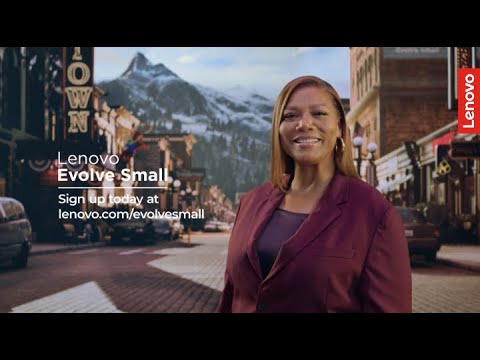
In 2021, Lenovo launched Evolve Small, a campaign centered on Queen Latifah’s role as a small business advocate. The initiative provided resources, mentorship, and technology to underrepresented entrepreneurs.
This campaign represented a maturation of Lenovo’s celebrity strategy. Unlike Kutcher’s engineering role, Queen Latifah’s involvement was not about product design; it was about values alignment. Lenovo positioned itself as a brand that understood the challenges of small business ownership—not abstractly, but through direct investment in real entrepreneurs.
The campaign also addressed a vulnerability in Lenovo’s brand architecture. While "For Those Who Do" celebrated individual achievement, "Evolve Small" acknowledged that achievement is rarely solitary. It requires community, capital, and institutional support. Lenovo claimed the role of enabler for that support system.
Link: Evolve Small – Queen Latifah Campaign (2021):
Act V: The Platform Pivot (2020s)
TikTok and the Creator Economy
Lenovo’s most recent advertising innovation is not a campaign but a channel strategy. The company has invested heavily in TikTok, not as a broadcast medium but as a creator ecosystem.
The distinction is critical. Traditional advertising pushes messages to audiences; TikTok campaigns invite audiences to participate in message creation. Lenovo provides creators with products, creative freedom, and distribution support. The resulting content is wildly heterogeneous: unboxing videos, productivity tips, gaming highlights, meme parodies.
This approach sacrifices the control that defines conventional advertising. Lenovo cannot ensure that every TikTok video reflects its desired brand image. But it gains something more valuable: credibility by association. When a trusted creator voluntarily features a Lenovo product, the endorsement is perceived as authentic. The brand becomes part of the creator’s identity narrative rather than an interruption to it
Comparative Table: Lenovo’s Advertising Evolution
| For Those Who Do | 2011 | Identity declaration | Ambitious professionals | Shifted from reliability to aspiration |
| Goodweird | 2015 | Generational bridging | Millennials/Gen Z | Normalized unconventional design |
| Ashton Kutcher | 2013 | Credibility transfer | Youth culture | Celebrity as collaborator, not endorser |
| Evolve Small | 2021 | Values demonstration | Small business owners | CSR integrated with brand narrative |
| TikTok Ecosystem | 2020s | Cultural participation | Creator economy | Surrendered control for authenticity |
Expert Analysis: The Lenovo Method
1. Strategic Bilingualism
Lenovo’s greatest advertising achievement is its ability to speak two languages fluently. To enterprise buyers, it communicates in the vocabulary of reliability, security, and total cost of ownership. To consumers, it communicates in the vocabulary of creativity, self-expression, and cultural belonging. These are not translations of a single message; they are independent messaging architectures calibrated for distinct audiences.
2. The Permission Architecture
"Goodweird" succeeded not because it was quirky but because it granted permission. Lenovo understood that many consumers felt constrained by the minimalist orthodoxy of Apple and the technical aggression of gaming brands. "Goodweird" said: you don't have to choose between professional seriousness and personal eccentricity. You can have both. This permission was more valuable than any product feature.
3. Celebrity as Stewardship
Lenovo’s celebrity partnerships differ from competitors’ in their duration and depth. Queen Latifah’s involvement with Evolve Small extends across years, not campaign cycles. This continuity transforms celebrity from a rented asset into a brand relationship. The celebrity becomes associated with Lenovo’s ongoing commitments, not momentary promotions.
4. Cultural Localization Without Condescension
Lenovo’s emerging-market advertising avoids the paternalism that often characterizes Western brands’ global campaigns. It does not present affordable technology as a charitable gift; it presents it as empowerment infrastructure. The tone is respect, not rescue.
Industry Impact: The Third Way
Lenovo’s advertising evolution created a third path in technology marketing, distinct from both Apple’s lifestyle minimalism and Samsung’s feature aggression:
Apple sells identity: Be creative. Be different. Be us.
Samsung sells capability: We can do what Apple does, but more.
Lenovo sells permission: You are already enough. Here are tools that respect who you are.
This positioning is uniquely sustainable. It does not require Lenovo to manufacture desire or superiority. It simply requires the brand to recognize and enable desires that already exist.
Competitors have noticed. Dell’s "Created for Those Who Create" campaign echoes Lenovo’s "For Those Who Do." HP’s diversity initiatives parallel Evolve Small. The industry is gradually converging on Lenovo’s insight: technology advertising is most effective when it validates the user rather than celebrating the product.
Conclusion: The Quiet Revolutionary
Lenovo’s advertising journey is a case study in strategic patience. The company spent its first decade proving it was worthy of the ThinkPad legacy. It spent its second decade establishing its own cultural voice. It is now spending its third decade distributing that voice across platforms and regions.
This gradualist approach stands in stark contrast to the technology industry’s preference for disruption narratives. Lenovo did not arrive with a manifesto or a savior CEO. It did not publicly reject its heritage or declare revolutionary intent. It simply, persistently, earned the right to speak.
"Goodweird" was not Lenovo’s rebellion against corporate identity; it was the flowering of a identity that had been quietly cultivated for years. "For Those Who Do" was not a repudiation of ThinkPad’s reliability legacy; it was an expansion of that legacy from passive durability to active creation.
Lenovo’s advertising teaches that brand transformation is not a single event but a continuous negotiation between heritage and aspiration, between global consistency and local relevance, between the respectability of the past and the permission of the future.
The ThinkPad remains black. The Yoga still bends. Legion laptops still glow with RGB ambition. But these products are no longer Lenovo’s primary message. They are merely the evidence for a larger claim: that technology, properly designed and honestly communicated, can help people become who they want to be.
That claim is not new. Apple made it decades ago. But Lenovo has made it accessible—not just in price, but in emotional tone. You do not need to be a genius to use Lenovo’s products. You do not need to be a revolutionary to be worthy of them. You just need to do.
And Lenovo will be there, quietly, persistently, when you do.
Explore Lenovo's innovative journey in technology advertising, showcasing how the brand has transformed its marketing strategies to connect with consumers.
I will teach you How to locate the serial number of your Lenovo product

Discover how to leverage viral challenges on TikTok to create impactful ads that engage audiences and boost your brand's visibility effectively.

Discover the iconic Adidas commercials that shaped basketball advertising, showcasing legendary athletes and unforgettable moments in sports marketing history.

Discover how Intel's innovative advertising strategies revolutionized computer marketing, shaping industry trends and consumer perceptions.

Discover how Huawei is transforming mobile advertising with innovative strategies and technologies, driving growth and engagement in the digital landscape.

Explore the impact of Adidas ads in football campaigns, showcasing innovative strategies and iconic moments that elevate brand engagement in the sport.

Discover Pizza Hut's most creative advertising slogans that have captured hearts and appetites. Explore the clever phrases that define their brand identity.

Discover how LG is transforming smart home advertising with innovative technology and strategies that enhance consumer engagement and drive sales.

Discover how Netflix leverages drama in its advertising campaigns to captivate audiences and enhance viewer engagement. Explore the art of storytelling in ads.