
In a world of fast fashion and accelerated consumerism, Patagonia stands as a beacon of radical coherence. More than a clothing brand, it is an environmental activism platform with textile production capabilities. Its marketing strategy, or rather its "anti-marketing," has challenged the fundamental rules of the industry: instead of encouraging limitless consumption, it questions it, and instead of spending fortunes on paid advertising, it invests in telling stories that matter. This approach, where sustainability is not a slogan, but the narrative axis of every campaign, has turned Patagonia into a global case study on how to build a powerful and loyal brand through authenticity and purpose.
This article explores Patagonia's unique philosophy, breaks down the strategies behind its iconic campaigns, and analyzes why its message, which at first glance might seem bad for business, has proven to be its greatest competitive advantage.
Foundational Philosophy: Purpose as the Main Product
Patagonia's communication strategy cannot be understood without its stated mission: "We're in business to save our home planet." This is not a marketing line, but the guiding principle for all its decisions, including advertising.
Minimalism in Paid Media: With spending on traditional advertising historically around less than 1% of its revenue, Patagonia rejects the noise of invasive advertising. Instead, it channels resources into documentaries, educational content, support for environmental organizations, and direct activism campaigns.
Storytelling with Substance: Its "ads" rarely sell product features. They are micro-documentaries celebrating nature, highlighting environmental threats, or sharing stories of activist communities. The brand positions itself not as the solution, but as a facilitator for those who want to be part of the solution.
Radical Transparency: From its Environmental Footprint Chronicles, which tracks the impact of its products, to the open admission of its own shortcomings, Patagonia operates with a level of transparency that disarms skepticism and builds unbreakable trust.
Key Strategies: Beyond the Ad, the Action
1. "Don't Buy This Jacket" - 2011
The Strategy: The ultimate anti-ad that redefined authenticity.
The Campaign: On Black Friday, the day of consumerism par excellence, Patagonia published a full-page ad in The New York Times with an image of its popular R2 jacket and the headline "Don't Buy This Jacket." The body text detailed the environmental cost of its production: the liters of water, CO2 emissions, and waste generated.
The Impact: This act of "reverse marketing" was a cultural earthquake. Instead of pushing customers away, it spoke to them as conscious adults. The implicit message was: "If you don't need it, don't buy it. If you need it, choose something made to last and with responsibility." The campaign did not harm sales; on the contrary, it boosted loyalty and turned the purchase into a statement of principles. It was living proof that asking for less can, paradoxically, generate more respect and business.
YouTube Link:
 Watch YouTube video
2. "Worn Wear"
The Strategy: Transforming the "use and throw away" culture into a celebration of durability.
The Campaign: More than a product line, Worn Wear is a philosophy. The campaign includes ads that are tributes to old, torn, and mended garments, free repair workshops, and a platform to buy and sell used Patagonia gear. Its commercials show real stories of customers whose jackets have lived adventures for decades.
The Impact: Patagonia decouples its growth from the consumption of new resources. By actively encouraging repair and resale, it extends the life cycle of its products and builds a circular economy. For the customer, every patch or darn stops being a defect and becomes a badge of honor, a story told in fabric. This creates an extremely deep emotional bond with the brand.
YouTube Link:
 Watch YouTube video
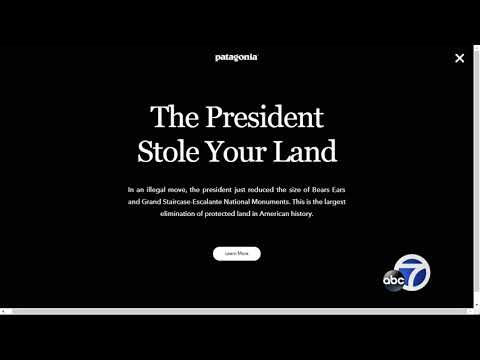
3. "The President Stole Your Land" - 2017
The Strategy: Direct political activism as brand communication.
The Campaign: In response to the U.S. government's decision to reduce the size of the Bears Ears and Grand Staircase-Escalante national monuments, Patagonia changed its homepage to a blunt message: "The President Stole Your Land." It launched a legal and lobbying campaign, using all its channels to mobilize citizens.
The Impact: The brand completely transcended the commercial sphere to position itself as a legitimate political actor in environmental defense. It took an enormous risk, alienating part of its customer base, but exponentially strengthened the loyalty of its core. It demonstrated that it was willing to "put its skin in the game" for its values, even in the face of political power, which for its followers is the ultimate test of authenticity.
YouTube Link:
 Watch YouTube video
Operational Integration: The Sustainability Behind the Message
Patagonia's credibility does not come from an advertising agency; it is built in its factories and supply chains. Its narrative campaigns are backed by concrete actions:
Materials: For Fall 2025, 86% of its styles (by weight) will incorporate preferred materials, such as recycled polyester and Regenerative Organic cotton.
Energy and Logistics: It is working towards 100% renewable energy in its operations and has joined the Zero Emission Maritime Buyers Alliance to decarbonize transportation.
The Risks of the Path: Authenticity Under a Microscope
This model is not without challenges. The main one is the constant exposure to scrutiny for "greenwashing." Any slip in its supply chain or contradiction between its message and its actions would be catastrophic. Furthermore, the cost of producing ethically and sustainably is higher, resulting in high prices that can limit its mass reach. Finally, there is the permanent tension of growing as a business while promoting a message of reduced consumption, an extremely delicate balance.
Conclusion: The Legacy of a Brand That Taught Businesses to Have a Conscience
Patagonia has demonstrated that the most powerful advertising is not that which sells a product, but that which sells a belief, a belonging, and a responsibility. It has redefined business success, showing that profitability and purpose are not exclusive, but can be synergistic.
Its legacy is a lesson for all industries: in an era of distrust towards corporations, radical authenticity, transparency, and the courage to defend values above immediate sales are the most solid foundations for an enduring brand. Patagonia does not tell us to buy; it invites us to think, to act, and only if it is truly necessary, to choose gear that is up to our commitment to the planet. In an ocean of commercial messages, its clear and firm voice remains the one that is heard the most, because it is the only one that speaks with the authority of someone who acts according to what they preach.
Discover the most captivating and quirky Nintendo ads that have left a lasting impression on gamers. Explore creativity and nostalgia in gaming marketing.
Discover the art of color grading and learn how editors transform food visuals into mouthwatering masterpieces that captivate audiences on screen.
Discover the breathtaking real-world locations featured in 2026 car ads. Explore stunning landscapes that enhance the allure of automotive advertising.
Explore the decline of jingles in advertising and discover why brands now favor licensed pop songs to capture audience attention and enhance engagement.
Discover how agencies select the ideal face for global campaigns, exploring the intricate process behind casting decisions and the impact on brand success.
Discover the art of storytelling in advertising with our list of 5 remarkable commercials shot in a single continuous take. Experience creativity in motion!
Discover how QR codes revolutionized commercial viewing, enhancing engagement and interactivity. Explore the impact on advertising strategies today.
Explore the evolution of self-aware and ironic commercials, uncovering their impact on advertising and consumer perception in today's media landscape.