

Scaling an advertising budget is one of the most delicate balancing acts in business. Too slow, and you leave revenue on the table. Too fast, and you burn cash while the algorithm resets, creative fatigues, and unit economics collapse.
The difference between successful scaling and catastrophic failure comes down to one fundamental truth:you cannot scale a leaky bucket.If your foundation is weak, increasing your budget will only increase your losses.
This guide will walk you through the five essential phases of budget management—from establishing your financial fundamentals to executing advanced scaling strategies—so you can grow revenue without destroying margin.
Phase 1: The Foundation (Before You Scale)
Before you even think about increasing spend, you must ensure your business can withstand the pressure of volume. Scaling amplifies everything—both profitability and inefficiency.
1. Know Your Unit Economics
Understanding your unit economics is non-negotiable. Without this clarity, scaling is gambling, not strategy.
-
Calculate your CAC (Customer Acquisition Cost):Total ad spend ÷ Number of new customers. This tells you how much you pay to acquire each customer.
-
Calculate your LTV (Lifetime Value):Average purchase value × Average number of purchases × Average customer lifespan. This tells you how much revenue a customer generates over their entire relationship with your business.
-
The Golden Ratio:Your LTV should be at least3xyour CAC. If it's lower, every new customer loses you money in the long run, and scaling will accelerate your path to insolvency.
This ratio is the bedrock of scalable advertising. When LTV exceeds CAC by a healthy margin, you have room to bid aggressively in auctions, test new channels, and absorb the inevitable inefficiencies that come with growth.
📺Watch:"The Only Metric That Matters"– Noah Kagan
🔗

2. Implement Strict Attribution
You cannot manage what you don't measure. Yet many advertisers rely on last-click attribution, which gives 100% credit to the final touchpoint—ignoring the awareness and consideration ads that actually drove the conversion.
-
Use UTMs:Tag every ad, creative, and campaign with unique tracking parameters. UTM codes allow you to see exactly which campaigns, sources, and even individual creatives are driving results.
-
Move beyond last-click:Implement multi-touch attribution (MTA) to distribute credit across the customer journey, or use marketing mix modeling (MMM) to understand the aggregate impact of your channels.
Without proper attribution, you risk cutting top-of-funnel campaigns that appear "unprofitable" in last-click reports but are actually essential for feeding your conversion campaigns.
📺Watch:"UTM Parameters Explained: Track Campaigns Like a Pro"– Analytics Mania
🔗

3. Set a "North Star" Metric
Different business stages require different optimization priorities. Optimizing for the wrong metric is a common scaling mistake.
-
Startup:Optimize forCPA (Cost Per Acquisition). Early on, proving that you can acquire customers at a sustainable cost is paramount.
-
Growth Stage:Optimize forROAS (Return on Ad Spend)orMER (Marketing Efficiency Ratio). At this stage, you need to ensure that ad spend consistently generates profitable revenue.
-
Mature:Optimize forProfit (Net Revenue after Ad Spend). As you scale, contribution margin matters more than top-line ROAS, which can be inflated by high-revenue, low-margin products.
Your North Star Metric keeps your team aligned and prevents optimization for vanity metrics like impressions or click-through rate at the expense of profitability.
Phase 2: Managing the Budget (Efficiency)
Before scaling horizontally (spending more), you must scale vertically (getting more out of every dollar you currently spend). Efficiency is the prerequisite for growth.
1. Use the 70/20/10 Rule
This allocation framework balances stability, growth, and innovation. It prevents you from betting everything on unproven concepts while ensuring you don't become stagnant.
-
70% to Proven Winners:Campaigns, audiences, and ad sets with a history of profitable performance. This is your cash cow.
-
20% to Scaling Tests:Expanding proven concepts to new audiences, geographies, or ad formats. This is where you find your next winners.
-
10% to Moonshots:Wild experiments—new creative angles, emerging platforms (like TikTok or Connected TV), or unproven funnel strategies. Most will fail, but the ones that succeed will fuel your next growth phase.
📺Watch:*"How to Scale Facebook Ads Using the 70/20/10 Rule"*– Ben Heath
🔗
2. Implement Frequency Caps
Ad fatigue is the silent budget killer. As frequency (the average number of times a person sees your ad) climbs, click-through rates decline and cost-per-mille (CPM) rises.
-
For social platforms (Facebook, Instagram, TikTok), set a frequency cap of2–4 impressions per week.
-
If frequency exceeds 4, your audience is becoming desensitized. Move budget away from high-frequency retargeting campaigns and toward prospecting campaigns to find fresh audiences.
📺Watch:"Ad Fatigue & Frequency: The Silent Budget Killer"– Jon Loomer
🔗

3. Dynamic Budget Allocation
Set-and-forget budgeting is a recipe for wasted spend. Ad platforms are volatile; what performs today may underperform tomorrow.
Use automated rules to create a "weather system" for your budget:
-
Pause ad sets that spend 50% of daily budget with zero conversions.
-
Shift budget from underperforming channels (high CPC, low CTR) to top performers.
-
Use platform rules (Google Ads scripts, Facebook automated rules) to automatically pause campaigns when CPA exceeds a set threshold.
📺Watch:"Facebook Ads Automated Rules: Save Money While Scaling"– Nick Theriot
🔗

Phase 3: Scaling the Budget (Growth)
Scaling is not simply adding $100 to a campaign. You must scale thestructureto accommodate higher spending without destabilizing performance.
1. Horizontal Scaling (The Safest Method)
Instead of increasing the budget on a single ad set—which can trigger the "learning phase" reset and increase CPMs—duplicate the winning ad set across similar audiences.
Create 3–5 duplicates of your winning campaign with slight variations (e.g., 1% lookalike vs. 2% lookalike, or different creative orders). This captures more volume without destabilizing the original campaign's algorithmic efficiency.
2. Vertical Scaling (Incrementally)
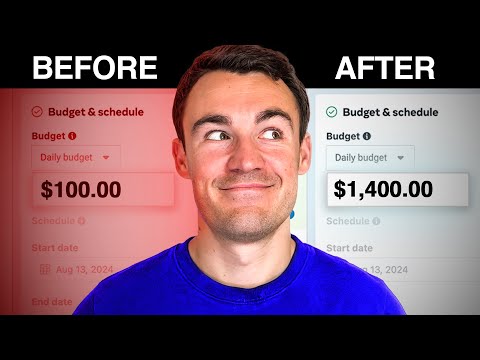
If you must increase budget on a single campaign, followThe 20% Rule:Never increase budget by more than 20% in a 24-hour period.
Why? A sudden 200% increase signals to the ad platform's algorithm that the campaign is "new," resetting the learning phase and causing high volatility for 3–7 days. Gradual increases maintain stability.
📺Watch:"How to Scale Facebook Ads (Horizontal vs Vertical Scaling)"– Nick Theriot
🔗

3. Channel Diversification
Every platform has a saturation point. When your CPM increases by 20% month-over-month despite consistent CTRs, you have hit diminishing returns.
The solution: use profits from your primary channel to fund testing on secondary channels. A brand heavily reliant on Meta should reinvest into Google Search, YouTube, TikTok, Connected TV, or podcasts. Diversification also protects you from platform-specific outages or policy changes.
📺Watch:"How to Diversify Your Ad Channels for Scalable Growth"– Aaron Young
4. Creative Velocity
Budget scales with creative, not with bidding. Creative fatigue is the #1 reason scaling fails.
-
Rule:You need to produce3–5 new ad concepts per weekfor every $10,000 spent per month.
-
Scaling Indicator:If you launch new creatives and CTR remains stable or increases, you can safely increase budget. If CTR drops, you need more creative volume.
📺Watch:"Creative Testing Framework for Scaling DTC Brands"– Nik Sharma
Phase 4: Managing Cash Flow & Seasonality
Even profitable scaling can bankrupt a business if cash flow isn't managed.
1. The Payment Gap
Advertising requires cashupfront, but revenue from platforms often takes days to settle. Credit card processors add another 2–3 days.
-
Risk:Scaling from $10,000/day to $50,000/day can drain operating cash within a week—even if you are profitable on paper.
-
Solution:Secure a line of credit or use a high-limit business credit card specifically for ad spend to smooth out the cash conversion cycle.
📺Watch:"The Hidden Cash Flow Trap in Ecommerce"– Alex Danco (Shopify Talks)
🔗
2. Anticipate Auction Inflation
During Q4 (Black Friday/Cyber Monday), CPMs can rise by 30–50% as brands compete aggressively.
-
Strategy:Lower your budget during the two weeks leading up to Black Friday when bidding is most competitive. Then increase budget during the "lull" between Christmas and New Year’s, when CPMs drop by up to 40%.
📺Watch:"Q4 Advertising Strategy: Surviving High CPMs"– Liam Walsh
🔗
Phase 5: Advanced Metrics to Watch While Scaling
As you scale, standard metrics (ROAS, CPA) become lagging indicators—they tell you what already happened. Use leading indicators to catch issues early.
| CTR (Click-Through Rate) | Drops by >20% | Creative fatigue. Pause old ads; launch new creative. |
| CPM (Cost Per Mille) | Rises by >20% | Audience saturation. Expand audience size or switch platform. |
| Hook Rate (Video) | Drops below 30% (first 3 sec) | Creative is not stopping the scroll. Reshoot the first frame/intro. |
| ATR (Add-to-Cart Rate) | Drops but CTR stays high | Website latency, pricing mismatch, or checkout friction. Fix UX before spending more. |
📺Watch:"The 3 Metrics Google & Meta Don't Want You to Track"– Katelyn Bourgoin
🔗
Bonus: Platform-Specific Scaling Strategies
Google Ads (Search)
When scaling search campaigns, structure matters more than budget. Use exact match for high-intent terms, separate brand vs. non-brand campaigns, and leverage smart bidding strategies like Target ROAS once you have sufficient conversion data.
📺Watch:"How to Scale Google Ads Without Breaking ROAS"– Surfside PPC
🔗
TikTok Ads
TikTok rewards native, authentic content. Scaling requires creative volume—test 10–20 creatives per week to find winners. Use Spark Ads to amplify organic content that is already resonating.
📺Watch:"TikTok Ads: Scaling From $1,000 to $50,000 Per Month"– Connor McGill
Meta Ads (Facebook & Instagram)
Use CBO (Campaign Budget Optimization) for scaling, but monitor for budget distribution issues. CBO tends to favor audiences with lower initial costs, which can starve high-intent but higher-cost audiences. Use cost caps to maintain efficiency as you scale.
📺Watch:"Facebook Ads CBO: How to Scale With Campaign Budget Optimization"– Ben Heath
Summary Checklist for Scaling
Before increasing your advertising budget, run through this checklist:
-
Verify:Is LTV ≥ 3x CAC? If not, fix unit economics first.
-
Stabilize:Are automated rules in place to pause losing ads?
-
Diversify:Are we relying on one channel or one ad account? (Never put 100% of budget into one Meta or Google account—they can be suspended without warning.)
-
Cash:Do we have 30–60 days of runway to cover the new ad spend before revenue arrives?
-
Creative:Do we have a pipeline of new assets ready to replace fatigued ones?
Conclusion
Managing and scaling an advertising budget is both a science and an art. The science lies in the metrics: LTV, CAC, CTR, CPM, and frequency caps. The art lies in knowing when to push and when to pull back, how to structure campaigns for stability, and how to maintain creative velocity.
By treating your advertising budget not just as a cost, but as a scalable arbitrage mechanism—where efficiency must be maintained while increasing volume—you can grow revenue without destroying margin.
Remember:scale the structure, not just the spend.Build a foundation that can handle volume, maintain efficiency before chasing growth, and always, always watch your leading indicators.
Discover the full cast of the X Town Square ad, featuring diverse talents and engaging performances that bring the campaign to life. Explore now!
Discover the catchy song featured in the HP Work from Anywhere commercial. Uncover the artist and lyrics that make this ad memorable and engaging.
Discover effective strategies for conducting market research to enhance your campaigns. Learn how to gather insights that drive successful marketing decisions.

Discover the filming locations of the iconic PlayStation live action commercial. Uncover the behind-the-scenes details and stunning settings used in the ad.

Discover the celebrity featured in the Fortnite skin commercial! Uncover the details and insights behind this exciting collaboration in our latest article.

Discover the stars of the Nintendo Switch 2 commercial! Find out who features in this exciting ad and what makes it a must-watch for gamers.

Discover the background song featured in the NBA 2K 2026 ad. Uncover the artist and track details that set the perfect vibe for the game.

Discover the artists featured in the EA Sports FC 2026 commercial. Uncover the music that sets the tone for this exciting gaming experience.

Discover the hidden meanings and Easter eggs in the Grand Theft Auto VI official trailer. Dive deep into the details that fans are buzzing about!

Discover the identity of the girl featured in the Fortnite crossover event commercial. Uncover her role and significance in this exciting gaming collaboration.

Discover the song featured in the Call of Duty 2026 launch trailer. Uncover the music that sets the tone for this highly anticipated game release.