
Programmatic advertising has become the dominant force in digital advertising, accounting for over90% of US digital display ad spendingand projected to approach$800 billion globally by 2028. If you're new to the concept, this guide will walk you through everything you need to know—what it is, how it works, the key players involved, and why it matters for modern marketers.
What is Programmatic Advertising?
Programmatic advertising is theautomated process of buying and selling digital ad spaceusing technology, data, and algorithms instead of manual negotiations. Rather than emailing publishers, negotiating prices, and signing insertion orders, advertisers set their campaign goals inside a software platform, and the technology handles the rest—all in milliseconds.
Think of it as anautopilot for ad buying. The software evaluates available ad impressions, decides which ones match your target audience, places bids, and serves the winning ad—all before a webpage finishes loading.
📺Video: Programmatic Advertising Explained (Beginner's Guide)
▶️
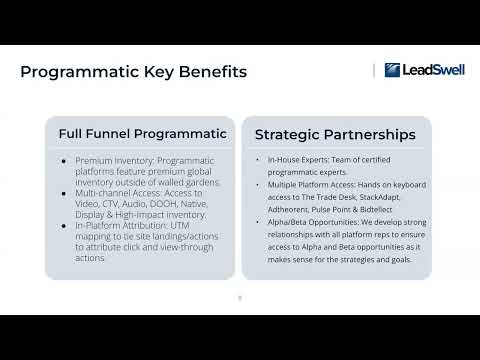
Este video ofrece una introducción clara y visual a la publicidad programática, explicando los conceptos fundamentales de manera accesible para principiantes.
Programmatic vs. Traditional Advertising
| Process | Manual negotiations, phone calls, insertion orders | Automated software, real-time auctions |
| Speed | Days or weeks to finalize deals | Milliseconds (under 120ms) |
| Targeting | Broad site lists, basic demographics | Granular: behavior, location, device, intent signals |
| Scale | Limited to negotiated placements | Millions of placements across thousands of sites |
| Transparency | Limited insight into where ads run | Real-time dashboards, full visibility |
| Optimization | Post-campaign reports | Real-time adjustments, AI-powered bidding |
Key takeaway:Programmatic replaces manual work with software that handles bidding, placement, and optimization at machine speed and scale.
How Programmatic Advertising Works: The Real-Time Auction
At the heart of programmatic advertising is a process calledReal-Time Bidding (RTB)—a lightning-fast auction that happens every time an ad slot becomes available.
Here's how it works, step by step:
Step 1: A User Visits a Website or App
A person opens a webpage or mobile app that contains ad space. That ad impression becomes available.
Step 2: The Publisher Offers the Impression
The publisher'sSupply-Side Platform (SSP)sends a "bid request" to anAd Exchange. This request includes information about:
-
The website or app domain
-
Ad format and size
-
Available user data (anonymized)
Step 3: Advertisers Evaluate and Bid
Multiple advertisers'Demand-Side Platforms (DSPs)receive the bid request. Each DSP analyzes whether the user matches the advertiser's target audience (based on demographics, behavior, location, etc.). If it's a match, the DSP submits a bid—how much the advertiser is willing to pay for that impression.
Step 4: The Highest Bid Wins
The Ad Exchange selects the highest bid. The winning advertiser's ad is sent to the publisher's SSP and displayed to the user.
Step 5: The Ad Renders
The entire process takesless than 120 milliseconds—faster than the blink of an eye.
📺Video: How Real-Time Bidding Works
▶️

Este video explica visualmente el proceso de Real-Time Bidding, mostrando cómo ocurre la subasta en milisegundos y qué información se transmite entre los diferentes sistemas.
The Key Players in the Programmatic Ecosystem
Programmatic advertising relies on four core technologies working together:
1. Demand-Side Platform (DSP)
What it is:The software advertisers use to buy ad space programmatically.
What it does:
-
Allows advertisers to set budgets, targeting criteria, and bid strategies
-
Connects to ad exchanges and SSPs
-
Automates bidding across thousands of publishers
Examples:Google Display & Video 360, The Trade Desk, Amazon DSP, Yahoo DSP, Adobe Advertising DSP
2. Supply-Side Platform (SSP)
What it is:The software publishers use to sell their ad space.
What it does:
-
Manages available ad inventory
-
Connects to multiple ad exchanges and DSPs
-
Helps publishers maximize revenue by exposing inventory to the largest pool of buyers
Examples:Google AdSense, Magnite, PubMatic
3. Ad Exchange
What it is:The digital marketplace where ad inventory is bought and sold in real time.
What it does:
-
Connects DSPs (buyers) with SSPs (sellers)
-
Facilitates the RTB auction
-
Ensures the highest bidder wins the impression
4. Data Management Platform (DMP)
What it is:A data warehouse that stores and organizes audience information.
What it does:
-
Collects and analyzes user data from various sources
-
Helps DSPs determine whether a user fits an advertiser's target demographic
-
Enables more precise audience targeting
📺Video: DSP vs. SSP vs. Ad Exchange: What's the Difference?
▶️

Este video desglosa las diferencias clave entre DSPs, SSPs y Ad Exchanges, explicando cómo cada componente contribuye al ecosistema programático.
Types of Programmatic Buying
Not all programmatic transactions are the same. There are four main deal types, each offering different levels of control, transparency, and access:
| Open Auction (RTB) | Inventory is open to all advertisers; impressions go to the highest bidder | Wide reach, cost efficiency, testing new campaigns |
| Private Marketplace (PMP) | Invitation-only auction; publishers offer premium inventory to select advertisers | Brand safety, premium placements, transparency |
| Preferred Deal | One advertiser gets "first look" at inventory at a fixed price before it goes to open auction | Securing quality placements with flexibility to pass |
| Programmatic Guaranteed | Direct deal between advertiser and publisher with fixed price and guaranteed volume | Major campaigns, guaranteed placements, brand-led initiatives |
Industry trend:Spending is shifting towardPMPs and programmatic direct, which now account for over 91% of US programmatic display spending. Advertisers are prioritizing inventory quality and brand safety over bid-price savings.
Key Benefits of Programmatic Advertising
1. Efficiency and Time Savings
Programmatic eliminates manual negotiation, insertion orders, and back-and-forth emails. What once took days or weeks now happens in milliseconds.
2. Smarter Targeting
Programmatic uses data signals—behavior, demographics, location, device, and contextual relevance—to deliver ads to the right users at the right time.
3. Cost Efficiency
Real-time auctions often reduce costs by eliminating wasted impressions. Advertisers pay market-driven prices rather than fixed rates.
4. Real-Time Optimization
Unlike traditional campaigns where you wait for post-campaign reports, programmatic dashboards update instantly.
5. Cross-Channel Reach
Programmatic isn't limited to display banners. It now spans display, video, connected TV, digital audio, and digital out-of-home.
6. Full-Funnel Measurement
Programmatic platforms provide transparent reporting on impressions, clicks, conversions, and return on ad spend (ROAS).
Programmatic Formats and Channels
Programmatic advertising has expanded far beyond banner ads. Here are the major channels where programmatic operates today:
| Display | Banner ads, rich media, native placements | Standard IAB sizes, native ads |
| Video | In-stream, out-stream, and in-app video ads | YouTube, TikTok, connected TV apps |
| Connected TV (CTV) | Ads on streaming television services | Hulu, Peacock, Netflix, Max |
| Digital Audio | Audio ads on streaming music and podcast platforms | Spotify, Pandora, podcast networks |
| Digital Out-of-Home (DOOH) | Digital screens in physical locations | Digital billboards, screens in gyms, malls, transit hubs |
| In-Game | Ads within mobile and console games | Rewarded video, playable ads, interstitials |
📺Video: Programmatic DOOH: Digital Out-of-Home Explained
▶️

Este video explora el mundo de la publicidad exterior digital programática, mostrando cómo las pantallas físicas se integran en el ecosistema programático.
📺Video: Connected TV Advertising 101
▶️
Este tutorial cubre los fundamentos de la publicidad en televisión conectada, incluyendo cómo se compra programáticamente el inventario de CTV y las métricas clave para medir el éxito.
How AI Is Transforming Programmatic in 2026
Artificial intelligence is reshaping programmatic advertising across the entire campaign lifecycle:
AI in Creative Production
-
60% of video advertisersuse AI for content creation
-
43%use AI for creative performance analysis
-
42%leverage AI for audience insights
-
40%use AI for dynamic creative optimization (DCO)
AI in Bidding and Optimization
Modern DSPs deploy AI-powered bidding systems that analyze historical behavior, purchase intent signals, and real-time engagement patterns to predict which impressions will drive conversions.
Example:Platforms like The Trade Desk's Kokai and Amazon DSP center AI optimization in their value propositions, automatically adjusting bids to maximize performance against advertiser goals.
AI on the Sell Side
Publishers are using AI-powered contextual targeting tools that scan live and on-demand content to match ads with relevant moments, improving relevance without relying on personal data.
Common Challenges and Considerations
Despite its advantages, programmatic advertising comes with challenges marketers need to address:
1. Ad Fraud and Waste
Global ad fraud losses are projected to reach$41.4 billion in 2025. Made-for-advertising (MFA) websites—low-quality sites mass-producing content to capture ad revenue—continue to siphon spending from legitimate publishers.
2. Supply Chain Opacity
According to the Association of National Advertisers, only43.9% of programmatic ad spendactually reaches consumers—the remainder is consumed by intermediary fees.
3. Platform Fragmentation
Each DSP, SSP, and walled garden operates with different interfaces, measurement standards, and data formats.
4. Identity and Targeting Uncertainty
While Google reversed its plan to deprecate third-party cookies in Chrome (April 2025), Safari and Firefox blocked third-party cookies years ago. Advertisers still face signal loss across browsers and must invest infirst-party data strategies.
📺Video: Programmatic Advertising Challenges and Solutions
▶️
Este video aborda los principales desafíos de la publicidad programática, incluyendo fraude, visibilidad y transparencia, y ofrece estrategias para mitigarlos.
How to Launch a Programmatic Campaign
Step 1: Define Your Audience and Goals
Before logging into a DSP, clarify:
-
Who do you want to reach?Demographics, behaviors, locations
-
What do you want to achieve?Brand awareness, leads, sales, app installs
Step 2: Build Strong Creative Assets
Programmatic spans multiple formats. Prepare variations of:
-
Display banners (standard and rich media)
-
Native ads
-
Video ads (multiple lengths for different placements)
-
Mobile formats
Step 3: Choose the Right DSP
Evaluate DSPs based on:
-
Fee transparency—Understand what percentage of spend reaches publishers
-
Supply path quality—Which inventory sources, how MFA sites are filtered
-
Measurement capabilities—Support for holdout testing, incrementality measurement
-
AI and workflow stability
Step 4: Set KPIs and Budget
Common programmatic KPIs include:
-
Impressions and reach—For awareness campaigns
-
Click-through rate (CTR)—Measure of engagement
-
Conversions—Onsite engagement, purchases
-
Return on Ad Spend (ROAS)—Profitability assessment
Step 5: Configure Campaign Settings
Inside your DSP, define:
-
Audience segments
-
Geographic targeting
-
Device targeting
-
Frequency caps
-
Bid strategy and budget caps
Step 6: Launch and Monitor
Once live, monitor performance dashboards in real time. Optimize based on what the data tells you—pause underperformers, scale winners, and continuously test creative variations.
📺Video: How to Set Up Your First Programmatic Campaign
▶️

Este video tutorial guía paso a paso la configuración de una campaña programática en una DSP, desde la selección de audiencia hasta la activación y optimización.
Quick Glossary: Key Programmatic Terms
| DSP | Demand-Side Platform—software advertisers use to buy ad space |
| SSP | Supply-Side Platform—software publishers use to sell ad space |
| Ad Exchange | Digital marketplace where ad inventory is bought and sold in real time |
| RTB | Real-Time Bidding—the auction process that powers most programmatic buying |
| PMP | Private Marketplace—invitation-only auction for premium inventory |
| Programmatic Direct | One-to-one deal between advertiser and publisher with fixed pricing |
| CPM | Cost Per Mille (thousand impressions)—common pricing model |
| DMP | Data Management Platform—warehouse for audience data |
| MFA | Made-For-Advertising—low-quality sites built primarily to host ads |
| CTV | Connected TV—television content delivered via internet-connected devices |
| DOOH | Digital Out-of-Home—digital screens in physical locations |
Conclusion
Programmatic advertising has transformed digital marketing from a manual, labor-intensive process into an automated, data-driven ecosystem that operates at machine speed. With over 90% of digital display ads now bought programmatically, understanding the basics is essential for any modern marketer.
Discover effective strategies for conducting market research to enhance your campaigns. Learn how to gather insights that drive successful marketing decisions.
Discover how visuals enhance advertising effectiveness, capturing attention and driving engagement. Explore the science behind impactful visual strategies.
Discover the art of crafting a compelling brand story that connects with your audience. Learn essential tips to elevate your brand's narrative and impact.
Discover effective strategies for leveraging user-generated content in your marketing campaigns to boost engagement and build brand loyalty.
Discover effective strategies for cross-promoting your products and services to boost visibility and drive sales. Maximize your marketing efforts today!
Discover the star-studded lineup of the Booking.com 2026 commercial. Find out who makes an appearance and what to expect from this exciting campaign.
Discover the captivating background song featured in Expedia's "Made to Travel" commercial. Uncover the artist and track that enhances your travel inspiration.
Discover the artist behind the captivating Alaska Airlines 2026 campaign ad. Uncover the voice that brings the ad to life and its significance.
Discover the meaning behind JetBlue's "You Above All" commercial. Explore its themes of customer care and connection that set JetBlue apart in the airline industry.
Discover the actor behind the iconic Southwest Airlines Wanna Get Away ad. Uncover the talent that brings humor and charm to this memorable campaign.
Discover the song featured in United Airlines' global destinations commercial. Uncover the melody that inspires wanderlust and connects travelers worldwide.